Ancient Landscape, Modern Times
Eric Ravilious and the Artists of the Chalk Downs
3 October 2026 to 10 January 2027
As a site of ancient hill carvings, expansive vistas and distinctive white cliffs, the chalklands of southern England became the focus of a number of twentieth-century artists, writers and thinkers.
The Holburne is delighted to present Ancient Landscape, Modern Times (3 October 2026 – 10 January 2027), an exhibition bringing together works by Eric Ravilious, William Nicholson, Paul Nash, John Nash, Tirzah Garwood, Peggy Angus and other British artists from the 1910s to the 1940s.
The exhibition has been developed by writer and curator James Russell, widely recognised as the leading authority on Eric Ravilious and his circle.
Through paintings, drawings, prints and archival material, the exhibition reveals how the stark, rolling forms of the South Downs and related chalk landscapes inspired a generation of artists seeking to reinvent landscape painting for the modern age, amidst growing political tensions and as Europe moved towards global conflict.
Ancient Landscape, Modern Times explores both the aesthetic and historical contexts of the landscapes of the South Downs and chalk landscapes of Wiltshire, Dorset and the Chilterns, examining how artists responded to their open horizons, sweeping contours and ancient monuments. At a time when aerial photography, archaeology and new forms of travel were transforming how people understood rural life, the chalk hills emerged as places where the distant past seemed unusually present.
Influential publications such as H.J. Massingham’s Downland Man (1926) celebrated these landscapes as repositories of deep history, while archaeological discoveries at sites such as Avebury and Maiden Castle fuelled widespread public fascination with Britain’s prehistoric past. A century after the publication of Massingham’s seminal text, this exhibition investigates for the first time this extraordinary collision of ancient and modern, idea and place, and the network of artists who chose to work – and live – in the chalklands.
This notion proved influential for artists including Paul Nash, whose encounters with the ancient landscapes of the Chilterns helped shape a lifelong commitment to capturing this terrain, traced from his earliest drawings The Wood on the Hill (1912) through to March Landscape (1944) painted just two years before his death. Elsewhere, William Nicholson’s studies of, first the Sussex Downs and later in Wiltshire, reveal a captivation with landscapes, the simplified forms and luminous light offering a radical alternative to conventional landscape painting as seen in On the Downs (1924).
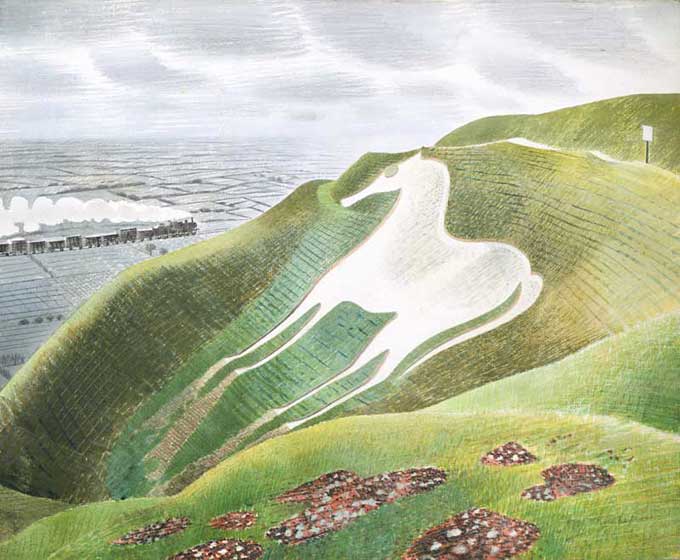
As understandings of Britain’s ancient past evolved alongside technological advances, artists increasingly combined prehistoric motifs with contemporary ways of seeing, viewing the chalk landscape as a subject capable of accommodating both tradition and modernity. Ravilious’s celebrated depictions of chalk hill figures and ancient monuments as seen in The Westbury Horse (1939), drawing on aerial viewpoints and modern graphic design as much as landscape tradition. Elsewhere, artists embraced the development of rural areas, depicting roads, motor travel, industry and new architecture. Sweeping depictions of industrial landscapes such as Peggy Angus’s Asham Cement Works (1934) and Tirzah Garwood’s Etna (1944) reveal how artists engaged with rapidly changing local environments while remaining attentive to the enduring presence of the land beneath them.
The chalk downs provided a place for memorial and recovery following the First World War. Soon after, the rise of fascism in Europe provided a backdrop for a new engagement with ancient English landscapes and, once the Second World War arrived, artists’ observed its intrusion into those places and reinforced the role of the chalk hills and cliffs of southern England as both strategic frontiers and potent national symbols. In watercolours such as Coastal Defences (1940), Firing a 9.2 Gun (1941) and Bombing the Channel Ports (1941), Ravilious fused the enduring forms of the landscape with the machinery of modern warfare whilst Paul Nash captured the uncanny intrusion of crashed German aircraft.
The exhibition concludes with a number of Nash’s final works, views of the distant chalk mounds, Wittenham Clumps, that had fascinated him all his life and which served as a subject of reflection on nature’s continuity even as he faced his final days. Across the exhibition, the chalklands emerge not simply as picturesque scenery but as places where artists negotiated questions of history, identity and belonging, revealing how ancient landscapes could speak powerfully to modern times.
Director of the Holburne, Chris Stephens, says: “I am so excited by Ancient Landscape, Modern Times which will bring together some of the most beautiful and compelling images of modern British art and consider them within the very particular contexts of the times in which they were made, a period of modernisation and of political drama.”
The exhibition is generously supported by Dreweatts.