
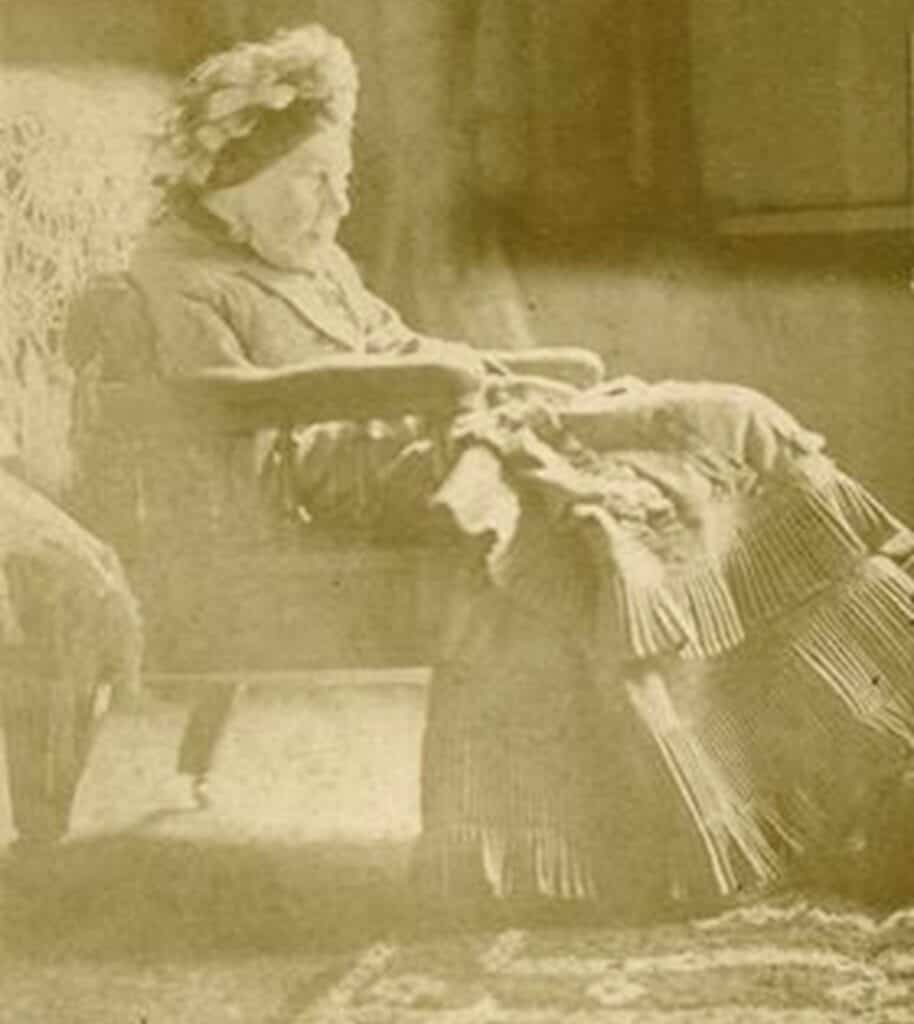
This International Women’s Day we are celebrating Mary Anne Barbara Holburne. While the Holburne Museum’s core collection comes from William Holburne, we owe our thanks to his sister, Mary Anne Barbara, who was key to establishing the museum.
Born in 1802 at 7 Lansdown Place, Bath, to Sir Francis and Lady Alicia Holburne, Barbara was the youngest of seven children:
- Francis Ralph Thomas Holburne (1788 – 1814)
- Alicia Sophia Anne Holburne (1789 – 1871)
- Edward Thomas Holburne (1791 – died in infancy)
- Catherine Frances Mary Holburne (1792 – 1873)
- Thomas William Holburne 5th Baronet of Menstrie (1793 – 1874)
- Francis Samuel Holburne (1800 – died in infancy)
- Mary Anne Barbara Holburne (1802 – 1882)
Raised amidst the elegance of high society, Anne would have relished attending social gatherings, theatre performances, musical evenings, and exhibitions. Following her mother’s passing in 1830, Barbara, William, Alicia, and Catherine took residence at 10 Cavendish Crescent, adorning the home in a refined classical manner, with crimson damask curtains, gilded wallpaper, and grained wood. Barbara remained there until her death in 1882, outliving all her siblings.
After Thomas William Holburne’s death in 1874, Barbara inherited William’s possessions. Barbara was resolute in her ambition to establish a museum, ensuring the preservation of his collection and the Holburne family legacy, as none of the siblings had children. In her later years, she formed a small committee, including Dr Charles Coates, physician at the Water Mineral Hospital, Rev H. Winwood, and W. J. Carlisle, her solicitor. This group gradually expanded to involve others from Cavendish Crescent and the wider Bath community. Barbara aspired for the collection to be housed at Sydney College, which was then derelict. Although she entered negotiations to acquire the site, her own poor health and ensuing legal complications prevented its purchase during her lifetime. Alongside her efforts to secure a permanent home for her brother’s collection, Barbara also actively supported charitable organisations, such as The Bath Royal Literary and Scientific Institute, helping them obtain Mr C. Moore’s geological collection.
However, after Barbara’s passing, it would take eleven years for the collection to secure a permanent home. This delay was largely due to the absence of a suitable building during Barbara’s lifetime, as well as ambiguities in her will’s codicil. The codicil, however, clearly expressed her desire for the museum to be open to the public and remain independent. Barbara bequeathed her house, possessions, and £10,000 to the Trustees,
for your own use and benefit… relying on your honour to carry out my wishes… I also empower you to make whatever changes you think desirable in regard to the collection so that my objects and intentions of preserving it as intact as possible may be borne in mind.
Her vision was to establish a museum of Fine Art for the City of Bath. During the eleven-year wait for a suitable location, the collection remained in Barbara’s home, tended by her servants. There was some consideration of opening the house to the public as a museum, but this was ultimately abandoned due to opposition from neighbours. Legal disputes concerning next of kin and the estate were resolved in 1886, enabling the formation of a charitable trust. Over the next six years, renewed negotiations took place regarding Sydney College, but without success. After inspecting sixteen properties, the trustees purchased the former Savings Bank Building on Charlotte Street, just off Queens Square, in February 1891. Following renovations, the museum opened to the public on 1 June 1893, drawing 5,000 visitors by the end of that year.
In 1913, the trustees finally succeeded in acquiring the Sydney College building after overcoming considerable legal hurdles and receiving funds from the estate of Mrs Granville, the last surviving relative of Barbara’s aunt, Catherine Cussans. Extensive renovations, led by architect Sir Reginald Blomfield, allowed the museum to move to its current home on Great Pulteney Street, opening its doors on 6 June 1916.
Although Mary Anne Barbara did not live to witness her brother’s collection being unveiled to the public, her aspiration for it to be housed in its present location was ultimately fulfilled. It is thanks to her unwavering determination that Bath has its first Art Museum and that we are able to enjoy the Holburne Museum today.
Book your tickets today to explore the amazing Holburne collection.
By Hannah N Mills, Assistant Curator